CHECK YOUR ELIGIBILITY
Your age, location and current health status are important. Check to see if you can become a blood stem cell donor.
Your stem cells could be the cure for someone with blood cancer.
Registration takes just 5 minutes with a simple cheek swab.
BAME donors are especially needed. Your match could be from your community.
Registration and donation are completely free. All costs covered by the NHS.
Often the last hope of a cure and simpler than most people think.
Most registered donors never get called, because a match is rare. Which is exactly why every extra donor counts.
A blood stem cell or bone marrow transplant is most often the last hope of a cure for many blood cancers and disorders.
Blood cancers such as leukaemia, lymphoma and myeloma can be treated with a blood stem cell transplant.
Donation is almost as simple as giving blood — but finding an HLA-matched donor is the hard part. HLA markers help your immune system tell your own cells from foreign ones.
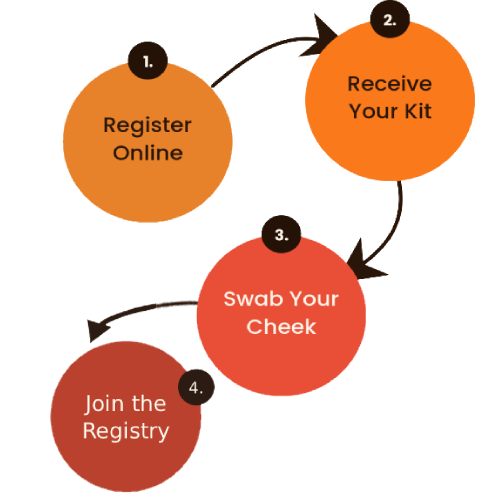
Four steps. Less than five minutes of your time. A lifetime of impact.
Fill out a simple form. No needles, no appointments.
5 minutesWe mail you a cheek swab kit with clear instructions.
Within 1 weekSwab your cheek and post it back. All postage prepaid.
2 minutesYou’re added to the international donor registry.
DoneThe whole campaign comes down to one remarkable cell. Here’s what it does and why a single donor match can rebuild a life.
Blood stem cells are the body’s blood-making cells. They live mostly in the soft marrow inside your bones.
They’re “unspecialised”, which means one stem cell can do two extraordinary things: copy itself, and grow into every type of blood cell your body needs to survive.
The body carefully balances how many of each cell are made, when they mature, and when old cells die.
Your bone marrow makes those master cells and matures them into red cells, white cells and platelets. Normally the whole process is tightly controlled — the right cells, in the right numbers, at the right time.
The right cells, in the right numbers, at the right time.
Immature “blast” cells crowd out everything that works.
Leukaemia breaks that control in two ways.
Some genetic mutations jam the accelerator, so cells divide relentlessly and ignore the signals that should tell them to stop.
Others block maturation altogether, so immature “blast” cells pile up and never become anything useful.
The marrow floods with cells that can’t do their job, which is exactly why the illness shows up the way it does:
With no working red cells to carry oxygen, patients feel exhausted and breathless.
With no working white cells, the immune system can’t fight illness off.
With no platelets, the blood can no longer clot as it should.
For people with leukaemia and other blood cancers, transfusions are often essential, not optional. Patients may need repeated transfusions throughout treatment:
to treat anaemia
to prevent life-threatening bleeding
to support the body during treatment
Stem cell transplants also depend on healthy donors joining the registry and falling numbers make suitable matches harder to find, especially for Black, Asian and minority-ethnic patients who are already under-represented. For the Kevin Kararwa Leukaemia Trust, that’s exactly why we champion both blood donation and stem cell registration, particularly among younger and more diverse communities who can help build a donor base that truly reflects the patients who need it.
Behind every figure is a person waiting for the one match that fits. Here is what the shortage looks like right now.
7 in 10 patients must find an unrelated donor to survive — someone they have never met.
The registry sounds large, but active, available donor numbers are falling worldwide.
Someone, somewhere in the world, is diagnosed with blood cancer. The clock does not stop.
Loyal, long-term donors are reaching an age where they can no longer give and younger people aren’t stepping in fast enough to replace them.
Packed schedules and competing priorities make it hard to find the time, especially when donating means travel or time off work.
Because shortages are rarely visible, many people assume there’s always enough blood or that someone else will give.
The pandemic cancelled sessions and broke long-standing habits. Many donors never returned, and remote working ended the routines that once made city-centre and workplace donation easy.
Safety rules rightly protect patients, but recent travel, some medical conditions, low iron, pregnancy, new medications or a recent tattoo can all rule a donor out, shrinking the eligible pool.
Needles, fainting, or the belief that giving is painful or slow still put first-timers off. In reality, a whole-blood donation takes about 5–10 minutes, with the whole visit around an hour.
Some ethnic communities have historically lower donation rates through low awareness, cultural beliefs, mistrust, language barriers or too little outreach. It matters hugely: patients with conditions like sickle cell often need closely matched blood from donors of similar heritage.
Even as donors decline, demand holds steady or grows — complex surgery, cancer treatment, trauma care, blood disorders and transplants all depend on supply. Every donation counts for more.
Traditional methods reach fewer people. Younger adults respond to social media, creators and digital campaigns far more than to leaflets or post.
With the cost of living high, many people put paid work and caring responsibilities first, even though donating is completely free.
Finding a stem cell match needs very specific genetic compatibility. Because markers vary across ethnic groups, patients from minority backgrounds face far slimmer odds.
Every registration from an under-represented community narrows this gap directly.
Out of thousands on the registry, your tissue type aligns with a patient’s. A coordinator gets in touch.
Further testing checks you’re the best available donor. You can ask any question along the way.
A thorough check-up ensures donating is safe for you as well as for the patient.
Peripheral blood stem cell collection takes a few hours as an outpatient. Bone marrow donation (10% of cases) is under anaesthetic.
Your body replaces the donated stem cells within weeks. Travel, accommodation and lost earnings are covered — donation is always voluntary.
Around 90% of donations
Over the four days before donating, you have injections that gently raise the number of stem cells in your blood. You can learn to give these yourself after a single nurse visit (what most donors choose), or have a nurse give all four.
At a specialist centre you relax while connected to a machine — much like giving platelets or plasma. It separates out the stem cells and returns the rest of your blood to you.
Occasionally you’re asked back the next day so enough cells are collected, the same easy process — and that’s it, you’ve helped save a life.
Around 10% of donations
In roughly one in ten cases it’s best to collect stem cells directly from the hip bones using a thin needle. It’s done under general anaesthetic, so you’re comfortable throughout.
You stay in hospital for up to 48 hours afterwards for monitoring and pain management.
Plan for around five days of rest as you recover — your energy may be lower than usual while your body heals.
You rest and recuperate while the team keeps in touch to check you’re feeling well. Your body replaces the stem cells that were collected within a few weeks to a couple of months, depending on the method.
Stem cell donation is considered very safe. As with any medical procedure there’s some small risk and possible temporary discomfort.
Donation means painful bone marrow extraction from the hip.
90% of donations are through peripheral blood — very similar to giving blood.
The process takes weeks and requires the donor to be hospitalised.
Most donations are outpatient and take only a few hours.
Donating leaves you in pain for weeks afterwards.
Most donors describe a few days of flu-like symptoms, or some soreness and bruising, and nothing more.
Special cells in your blood that can grow into healthy new blood cells. They are used to treat blood cancers and disorders such as leukaemia, lymphoma and sickle cell disease.
There are two methods:
Peripheral Blood Stem Cell (PBSC) — 90% of donations. Similar to giving blood, using a machine that collects stem cells from your blood.
Bone marrow — 10% of donations. Taken from the pelvic bone under anaesthetic.
With PBSC you may feel flu-like symptoms for a few days from the injections that boost stem cells. With bone marrow donation you may feel sore or bruised for a few days afterwards.
It varies by charity, but generally ages 16–55 and in good general health. Some organisations only accept people aged 17–30, because younger donors give the best outcomes.
Sign up online with a donor charity such as DKMS, Anthony Nolan, KKLT or NHSBT.
Not always. Most people never donate — but if you are a match for someone in need, you could save their life.
Patients are most likely to match someone who shares their ethnic background. Match chances for many BAME patients remain much lower than for white European patients.
A match is when your tissue type (HLA type) closely aligns with a patient’s. This helps the body accept the healthy stem cells.
Yes. Donors are thoroughly checked, monitored and supported throughout. Your body naturally replaces donated stem cells within weeks.
You can withdraw any time before a patient begins treatment. Once they start chemotherapy to wipe out their immune system, they rely on your donation.
Most registries remove donors at age 60 or earlier, in line with medical guidelines.
Yes. Some donors are matched with more than one patient over time.
No — donation is voluntary. But travel, accommodation and any loss of earnings are usually covered.
Depending on the country and register rules, some donors and patients can meet after a waiting period, if both agree.
Your age, location and current health status are important. Check to see if you can become a blood stem cell donor.